Mastering Visual Language: The Practical Power of Neue Reman Grotesk
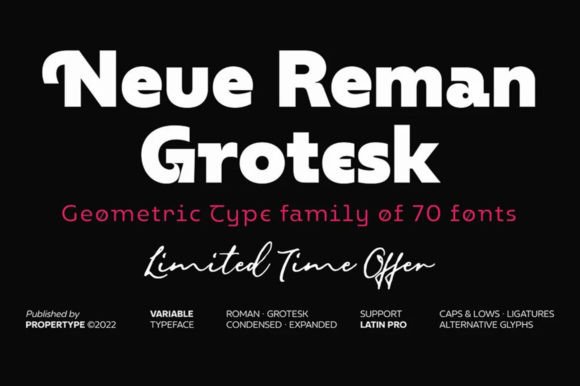
When you are designing a digital interface or drafting a brand identity, the typography you choose acts as the voice of your content before the reader even processes a single word. In the world of sans-serif typefaces, finding a balance between mechanical precision and human warmth is often the "holy grail" for designers. This is exactly where Neue Reman Grotesk establishes its presence. It is not just another geometric font; it is a comprehensive visual system designed for the complexities of modern communication. With a total of 70 font styles bundled into a single variable file, this typeface offers a level of flexibility that is rarely seen in standard font families.
At its core, Neue Reman Grotesk is a Latin Pro font that supports an impressive 192 languages. This extensive linguistic coverage makes it a practical choice for global brands that need to maintain visual consistency across different regions. Whether you are localizing a website for European markets or creating multilingual packaging, the transition between character sets remains seamless. The second version of the Neue Reman Family brings refined proportions and a massive glyph count of 750 characters per style, ensuring that typographic gaps are filled before they become problems.
Beyond the Basic Weights: The Variable Advantage
One of the most significant upgrades in this version is the inclusion of a Variable font file. For the modern web developer or app designer, file size and load times are critical metrics. Instead of loading ten different font files for various weights and styles, you can utilize a single variable file. This allows for fluid animation of text weight and width, creating dynamic user experiences that respond to scrolling or interaction. You can move smoothly from a Thin weight to a Black weight without the harsh jumps associated with static fonts. This fluidity is essential for responsive design, where typography needs to adapt not just to screen size, but to the context of the content.
Real-World Application: From Corporate to Creative
The versatility of Neue Reman Grotesk lies in its "Grotesk" style, which balances neutrality with character. It doesn't scream for attention, but it commands respect. This makes it incredibly effective across a variety of sectors.
1. Branding and Corporate Identity
For startups and established enterprises alike, a typeface must convey trustworthiness. Imagine a fintech app that needs to display complex data tables alongside friendly onboarding messages. The tabular figures in Neue Reman Grotesk ensure that numbers align perfectly in financial reports, while the proportional figures keep general body text looking natural. This dual capability means you don't need separate fonts for your accounting department and your marketing team. The consistency of the visual language builds brand equity over time.
2. Editorial and Publishing
In long-form reading environments, such as digital magazines or e-books, legibility is paramount. However, editors also crave personality. The Stylistic Alternates and Stylistic Sets included in this family allow you to swap out specific letterforms to change the "flavor" of the text. You can opt for a more traditional 'a' or 'g' for a classic novel feel, or stick to the standard forms for a news report. This allows a single typeface to serve multiple publication moods without changing the font stack.
3. User Interface (UI) and System Design
System designers often struggle with micro-typography. How do you handle ordinals, superscripts, and scientific inferiors without them looking clumsy or shrinking into illegibility? Because Neue Reman Grotesk was built with these features as standard, not afterthoughts, the scaling is optically adjusted. This is particularly useful for scientific applications or educational software where precise notation is non-negotiable. The inclusion of arrows and specialized symbols also reduces the need for external icon libraries in some minimal interface designs.
The Technical Edge: OpenType Features in Practice
Typography is as much about the code as it is about the curve. Neue Reman Grotesk is packed with OpenType features, but these only work if you are using an application program that supports them. Tools like Adobe Illustrator, Photoshop, InDesign, and modern web browsers (via CSS) can unlock the full potential of this font.
Consider the use of Standard and Discretionary Ligatures. In a large headline, turning on discretionary ligatures can add a touch of elegance by connecting letters like 'fi' or 'fl' in unique ways. Conversely, in a dense UI dashboard, you might want to ensure ligatures are off to maintain a strictly grid-based aesthetic. The control is in your hands.
Furthermore, the Caps Swashes Letters offer a creative tool for logo design. Instead of using a script font that might be hard to read, you can use the Grotesk base for legibility and apply swashes to the initials for a custom, bespoke look. This is a subtle way to make a brand feel high-end without sacrificing accessibility.
Strategic Selection: When to Choose This Typeface
Choosing a typeface is a strategic decision. Neue Reman Grotesk is an excellent solution for projects that require a "workhorse" font with high-end features. It is suitable for:
- Multi-platform Branding: If your brand exists on billboards, mobile apps, and print brochures, you need a font that renders well on low-res screens and high-res prints.
- Data-Rich Environments: The inclusion of tabular figures, fractions, and scientific inferiors makes it ideal for annual reports, dashboards, and technical manuals.
- Global Reach: With support for over 192 languages, it solves the headache of mixing typefaces when translating content into languages with extended Latin characters.
Practical Considerations and Limitations
While the font is robust, it is important to acknowledge the learning curve associated with variable fonts and advanced OpenType features. If your workflow relies on older software that does not support variable font technology, you may not be able to utilize the single-file advantage and will need to install the static weights individually. Additionally, because it is a Grotesque sans-serif, it carries a specific mid-century modern aesthetic. While this is highly adaptable, projects requiring a strictly humanist or calligraphic feel might find the geometric structure of Neue Reman Grotesk too rigid.
Another consideration is file management. With 750 glyphs per style, the font files are larger than a basic, stripped-down typeface. While the variable file helps mitigate this for web use, it is still a "heavy" font in terms of data. Designers should ensure they are subsetting the font (including only the characters and features they need) when deploying it on performance-critical websites to ensure optimal load speeds.
Unlocking the Potential
The true value of Neue Reman Grotesk is realized when you move beyond typing words and start treating the font as a design element. By utilizing the Discretionary Ligatures for a wedding invitation or the Superscripts for a chemistry textbook, you are leveraging the engineering that went into the 70 styles of this family. It bridges the gap between the mechanical precision required for coding and data, and the aesthetic warmth required for storytelling. For the designer who needs one reliable, expressive, and technically superior typeface to handle the chaos of modern projects, this font family offers a compelling answer.