Wedding Monograms: A Victorian-Inspired Font for Timeless Elegance
In the digital age of wedding planning, where minimalist sans-serifs and rustic scripts dominate, there is a distinct and growing desire for typography that speaks to history and permanence. The Wedding Monograms font family addresses this specific need. It is not merely a typeface; it is a functional tool designed for a singular, prestigious purpose: creating two-character monograms that evoke the sophistication of the late 19th century. For designers, stationers, and couples seeking a visual language of heritage, this font family offers a direct bridge to the ornate aesthetic of the Victorian era.
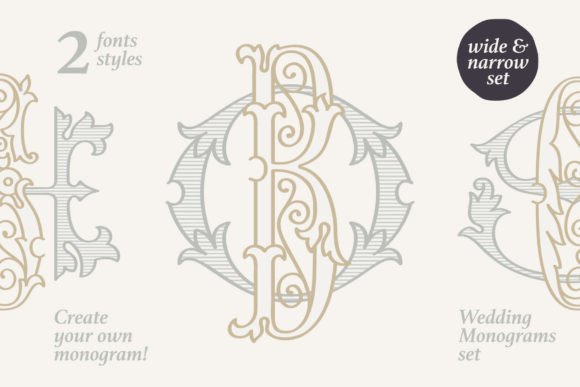
The core identity of Wedding Monograms is rooted in its historical inspiration. The family draws directly from the “Course of women’s needlework,” a publication from 1887. This origin is significant because it grounds the design in a specific cultural context—the height of the Arts and Crafts movement and the tail end of the Victorian period, when personal monograms were not just decorative flourishes but markers of identity and status, meticulously stitched into linens and garments. The font translates that intricate, handcrafted needlework aesthetic into a scalable digital format, preserving the delicate weight, balanced proportions, and ornamental details that characterize that era's typography.
Anatomy of an Elegant Historical Style
Understanding the technical and visual characteristics of Wedding Monograms is essential for evaluating its utility. The font is structured around a two-character ligature system, meaning its primary function is to seamlessly merge two initials—typically the first names of the partners—into a single, cohesive mark. This is achieved through carefully designed kerning pairs and stylistic alternates that allow the letters to interlock without visual clutter.
- Character Structure: The letterforms feature moderate contrast between thick and thin strokes, avoiding the extreme stress of high-fashion Didones. The terminals often end in subtle, rounded flourishes reminiscent of needlework knots, rather than sharp, calligraphic cuts.
- Ornamentation: The decorative elements are integrated into the letter shapes themselves, rather than being added as separate glyphs. This ensures that the monogram remains a unified piece, which is crucial for applications like wax seals, embroidery files, or foil stamping.
- Legibility at Scale: While ornate, the design prioritizes clarity. The internal counters (the enclosed spaces within letters like 'O', 'D', or 'B') are open enough to remain distinct even when the monogram is reduced to smaller sizes, such as on envelope flaps or program covers.
Practical Application in Modern Wedding Design
The practical value of a specialized font like Wedding Monograms lies in its ability to streamline the creation of a bespoke visual identity. For a graphic designer or a stationery professional, using a general-purpose serif font to create a monogram often requires extensive manual adjustment—nudging letters closer, redrawing connections, and ensuring that the visual weight is balanced. This font family solves that problem at the source.
Consider a scenario where a couple desires a classic, formal invitation suite. Using Wedding Monograms, the designer can quickly generate a primary mark that can be consistently applied across all collateral. The monogram created from this font works exceptionally well in specific production methods:
- Engraving and Letterpress: The clean, defined edges of the characters reproduce faithfully in intaglio printing, where ink is pressed into the paper. The historical weight of the design complements the tactile nature of these traditional methods.
- Digital Foil Stamping: In modern hot-foil processes, intricate serifs and thin strokes can sometimes fail or fill in. The balanced stroke width of this font family minimizes production errors, making it a reliable choice for metallic applications on thick card stock.
- Embroidery and Signage: Because the inspiration is needlework, the design translates logically to thread. The lack of hairline thins means the monogram can be stitched onto napkins, robes, or dance floors without breaking the continuity of the thread path.
Usability, Flexibility, and Workflow Integration
From a workflow perspective, the font integrates into standard design software (such as Adobe Illustrator, InDesign, or Affinity Designer) as an OpenType font. Users with a basic understanding of OpenType features can access the stylistic alternates and ligatures that define the Wedding Monograms aesthetic. However, it is worth noting that achieving the perfect interlock may still require manual kerning depending on the specific letter combination chosen (e.g., an 'A' and a 'V' behave differently than an 'S' and a 'C').
The consistency of the family is a strong point. The metrics are designed so that the vertical and horizontal alignment remains stable across different letter pairings. This reliability is crucial when the monogram is used as a watermark or a background pattern, where uneven spacing can create a visual vibration that distracts the eye. The font maintains a steady rhythm, ensuring that the "white space" around and within the letters is harmonious.
Evaluating Strengths and Realistic Limitations
The primary strength of Wedding Monograms is its authenticity. It does not attempt to simulate history; it replicates a documented historical style with precision. This makes it an authoritative choice for projects that aim for a specific period look, rather than a generic "vintage" feel.
However, objective evaluation requires acknowledging its constraints. This is a highly specialized tool. It is not designed for body text, and its utility outside of monogram creation or short, decorative headlines is limited. Furthermore, because it is based on a distinct 1887 style, it pairs best with typefaces from similar eras—such as transitional serifs or humanist sans-serifs—rather than modern geometric fonts, which can create a jarring temporal dissonance.
Another consideration is the complexity of the ornaments. In very small digital displays (such as a mobile screen at 10px), the intricate details that define the Victorian aesthetic may blur or become muddy. Therefore, for digital-first applications (like a wedding website header), it is advisable to use the monogram at a larger display size or simplify the design for favicons and mobile icons.
Who Benefits from This Font Family?
The utility of Wedding Monograms extends to several professional groups:
- Wedding Stationers: Professionals who need to offer clients a quick, elegant solution for custom stationery without commissioning a hand-lettering artist for every project.
- Graphic Designers: Specialists in branding who work with clients seeking a heritage or luxury market position. The font can serve as a foundational element for a brand identity system.
- DIY Planners: Couples with access to design software who possess the technical skill to use OpenType features but lack the drawing ability to create a monogram from scratch.
- Signage and Décor Vendors: Businesses that produce physical goods like cake toppers, laser-cut wood signs, or vinyl decals, where vector-ready, clean typography is a production requirement.
Conclusion: A Tool for Timeless Identity
In summary, Wedding Monograms is a niche but highly effective typographic resource. Its value lies in its historical accuracy, its structural suitability for two-character combination, and its adaptability across both traditional print and modern fabrication techniques. While it requires a thoughtful approach to pairing and sizing, its ability to instantly convey elegance and heritage makes it a worthwhile addition to the toolkit of any designer or individual tasked with creating a lasting visual symbol for a union. It successfully bridges the gap between the meticulous craft of 1887 and the digital precision of today.